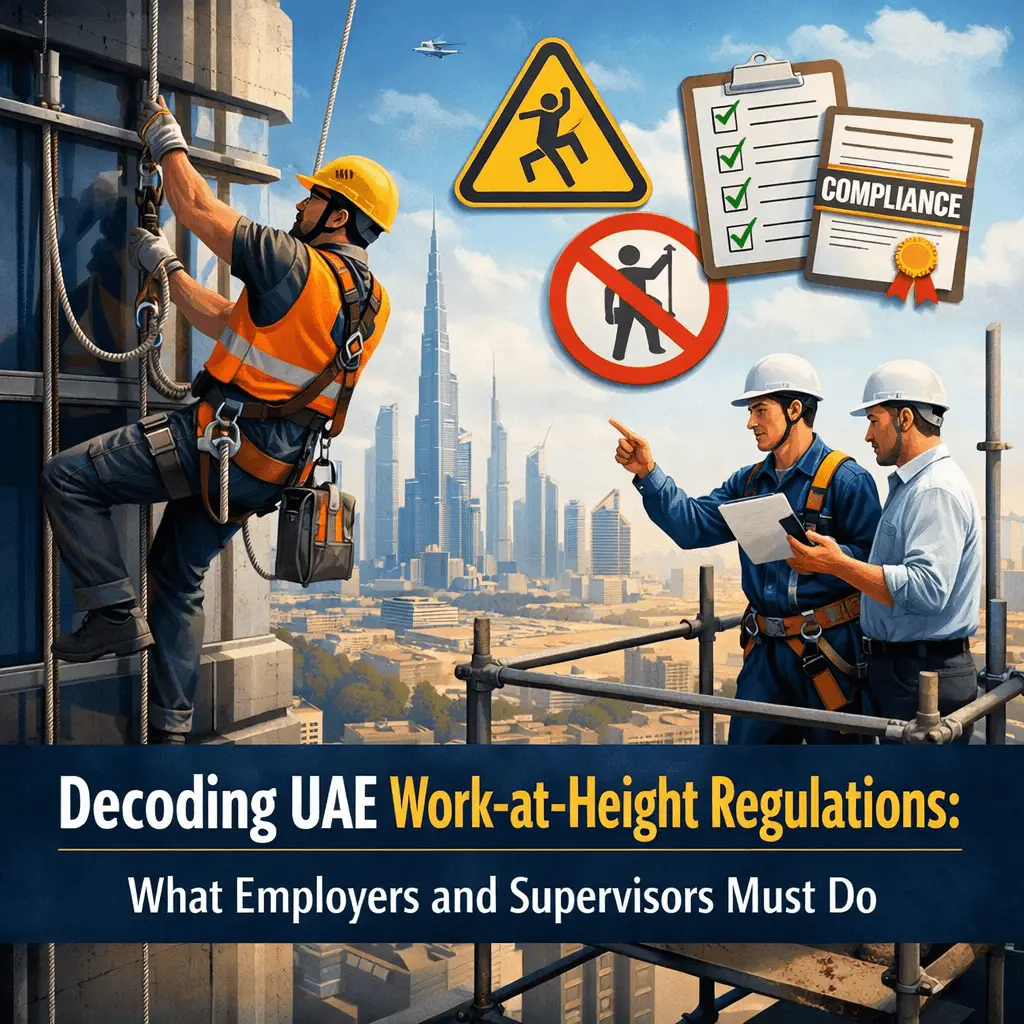
Falls from height remain one of the top causes of workplace injuries in the UAE. Whether it’s construction, FM, MEP, warehousing, or even routine maintenance, any job completed above ground level is treated as “work at height” under UAE safety standards. That’s why regulators—and insurers—expect employers to prove that hazards are controlled, workers are trained, and supervision is competent.
This guide breaks down the essentials of UAE work-at-height requirements and where Work at Height Training fits into compliance.
What “Work at Height” Means in the UAE
The UAE adopts a broad definition used in international best practice: any task performed where a person could fall and injure themselves qualifies. This includes:
- Scaffolds, mobile towers, MEWPs, and ladders
- Loading bays and elevated platforms
- Working near fragile surfaces
- Roof work
- Deep excavations or shafts
If someone can fall—even a short distance—the rules apply.
Legal Framework Employers Must Follow
While each emirate has its own enforcement authority, the core requirements come from:
- UAE Labour Law (Federal Decree-Law No. 33 of 2021) – employer’s duty to provide a safe working environment
- Ministerial Decision No. 44 of 2023 – prevention of occupational hazards
- OSHA / UK HSE standards – widely adopted as guidance in the UAE
- Dubai Municipality Code of Construction Safety Practice
- ADQCC / OSHAD SF (Abu Dhabi) – mandatory system for Abu Dhabi entities
Across all these frameworks, one common requirement appears: workers and supervisors must receive appropriate Work at Height Training and refresher sessions before they can be assigned to elevated tasks.
Employer Responsibilities
a) Conduct a Work-at-Height Risk Assessment
This is non-negotiable. Employers must assess:
- The task
- The height
- Tools and equipment
- Potential fall zones
- Weather conditions
- Competence of workers
The selected method (scaffold, MEWP, ladder, restraint system, etc.) must be the safest practicable option.
b) Provide the Right Equipment
The UAE expects employers to supply certified:
- Fall-arrest and restraint systems
- Harnesses & lanyards
- Anchor points
- Guardrails and edge protection
- Properly inspected ladders and platforms
Equipment must be compatible, inspected before use, and stored correctly.
c) Ensure Workers Are Trained and Competent
No worker should be operating at height without formal training. This includes:
- Identifying fall hazards
- Safe use of ladders, scaffolds, and MEWPs
- Emergency rescue techniques
- Inspection of PPE
- Understanding load limits and stability
Many companies now choose Online Work at Height Training for theory sessions because it reduces downtime and keeps records easy to manage, while practical training happens onsite or at an accredited center.
d) Appoint a Competent Supervisor
Supervisors must:
- Verify risk assessments
- Authorise work-at-height permits (where required)
- Check equipment before shifts
- Monitor weather and site risks
- Step in if unsafe activity is observed
Their responsibility is not just oversight—it’s intervention.
e) Put an Emergency Rescue Plan in Place
Regulations in the UAE clearly state: It’s not enough to rely on public emergency services.
Employers must prepare their own:
- Rescue procedures
- Trained rescue personnel
- Suitable recovery equipment
A rescue plan must be tested, documented, and understood by the team.
Supervisor Responsibilities
Supervisors are personally accountable for:
- Authorising workers based on training validity
- Ensuring daily ladder/scaffold checks
- Enforcing PPE rules
- Logging and reporting near misses
- Ensuring housekeeping to eliminate trip hazards
They act as the bridge between policy and practice.
Why Work-at-Height Training Is Non-Negotiable
Training isn’t just a legal tick-box. It reduces:
- Falls
- Dropped-object accidents
- Equipment misuse
- Scaffold/ladder failures
- Rescue delays
Work at Height Training—delivered face-to-face or as Online Work at Height Training—helps employers demonstrate regulatory compliance, protects workers, and reduces insurance risks.
Most organisations adopt a blended model:
- Online theory → hazards, legal requirements, safe systems of work
- Practical assessment → harness fitting, ladder checks, scaffold access, rescue practice
This meets UAE inspector expectations for competence.
Key Takeaways for Employers
Here’s the checklist you actually need:
- Conduct a site-specific risk assessment
- Choose the safest possible work method
- Use only certified access equipment
- Provide Work at Height Training and refreshers
- Appoint competent supervisors
- Maintain documented inspections
- Prepare and test your rescue plan
- Monitor weather, site conditions, and behaviour
Compliance is ongoing, not one-time.
Final Word
UAE regulators take work-at-height safety seriously—and so do clients and insurers. When employers combine solid planning with proper equipment and certified training, they not only comply with the law but also create safer, more productive worksites.
If you want, I can create a shorter version, a social-friendly version, or add internal links and CTAs tailored to your training institute’s offerings.